Table of contents
Once confined to a handful of coastal surf shops, wingfoiling has become a fast-moving retail category driven as much by logistics and user reviews as by wind and swell, and the shift is reshaping how riders discover, compare, and buy equipment. The timing is no accident: post-pandemic participation in outdoor water sports has stayed resilient, while brands have leaned into direct-to-consumer sales, faster product cycles, and data-led merchandising. For newcomers, the upside is choice and transparency, but the downside is complexity, because the difference between a great first session and a frustrating one often comes down to the right setup.
Why wingfoiling sales moved online
Walk into a traditional surf shop and you can still feel the old retail logic at work: touch the canopy fabric, flex a handle, ask a local what works in the prevailing breeze, and leave with something that fits your spot. But the economics of wingfoiling have pushed the market beyond that model, and not only because many riders live far from specialized stores. Wingfoiling gear is bulky, high-ticket, and highly configurable, and those three traits reward sellers who can hold inventory centrally, ship efficiently, and present a wide range of options without dedicating expensive floor space to every size and variant.
That shift mirrors broader e-commerce trends, where consumers increasingly expect deep catalogs and price visibility, yet wingfoiling adds its own twist: a buyer rarely needs just one product. A complete setup typically involves a wing, board, foil, mast, fuselage, front and rear wings, plus safety and convenience items such as leashes and pumps, and each choice influences the next. In a physical store, that “system purchase” can be guided by a staff member, whereas online it is guided by structure: comparison tables, recommended bundles, size charts, and customer support that can translate skill level and local wind range into a coherent cart.
Data has become the quiet engine of this change. Online, retailers can see which wing sizes are searched most in specific seasons, which boards are returned more often, and which foil setups lead to follow-up purchases rather than regret, and that information feeds back into stocking decisions and product descriptions. Reviews and community feedback also scale faster on the web than in-store word of mouth, creating a loop where buyers arrive better informed, but also more demanding, because they can cross-check claims across forums, video tests, and independent gear roundups before clicking “buy”.
There is also a practical driver: specialization. Wingfoiling has expanded quickly, but the learning curve remains real, and many generalist water-sports retailers cannot carry enough depth to serve beginners and advanced riders at once. Online stores can cater to niche needs, whether it is lightweight wings for marginal wind, compact boards for travel, or foils tuned for speed, surf, or freeride, and the ability to filter, sort, and compare at home has turned what used to be a regional shopping trip into a global market.
How buyers judge gear without touching it
Buying wingfoiling equipment online can feel like a leap, because the sensory cues of a shop are missing, and yet consumers have developed a new toolkit to replace them. Spec sheets now matter more than ever, not as marketing fluff, but as decision-making anchors: wing area in square meters, materials and reinforcement layouts, board volume in liters, foil surface area, aspect ratio, and mast length. Those numbers do not tell the whole story, but they narrow the field quickly, and they help a rider avoid the most common mistake, which is choosing gear that is too small, too technical, or too specialized for the first months on the water.
Video has become the new “try before you buy”, and not just glossy brand clips. Independent tests, side-by-side comparisons, and long-form reviews show how a wing flags when surfed, how stable it feels when luffing, and whether the handles or boom setup suits different riding styles. At the same time, customer reviews fill in the unglamorous truths: durability of leading-edge seams after a season, how easy a valve is to use with cold hands, whether a board’s deck pad stays grippy, and how a foil behaves in choppy water. The best retailers curate that information, because a wall of unstructured reviews can mislead as easily as it can inform.
Fit and progression are the other pillars of online decision-making, and this is where good product guidance becomes decisive. A beginner’s “right” wing size depends not only on wind strength, but also on rider weight, local gustiness, and whether the goal is cruising or learning to gybe; similarly, foil selection balances lift, stability, and speed. Retailers that invest in clear progression pathways, beginner-friendly bundles, and responsive support reduce the chance of expensive mismatch, while also building trust that translates into repeat purchases as riders upgrade.
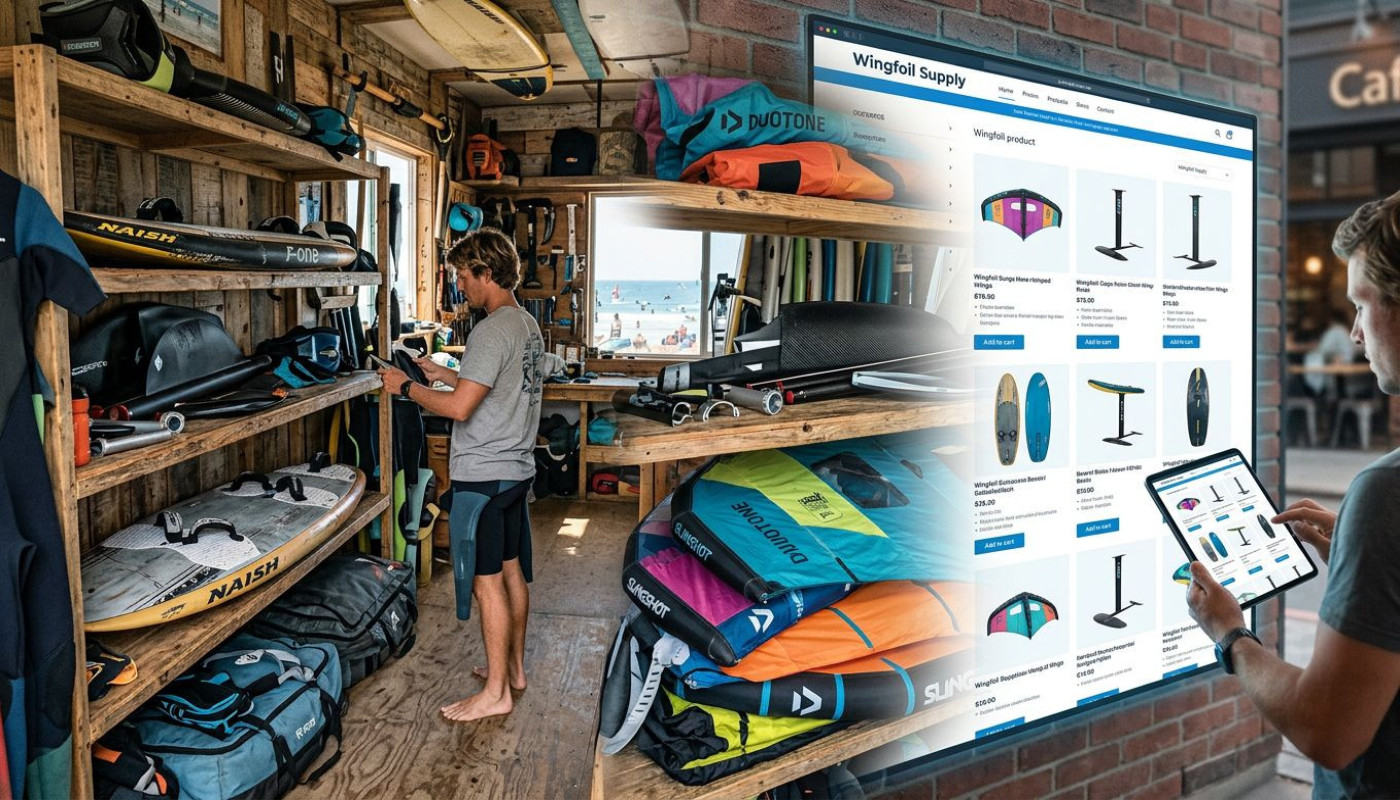
In that context, the emergence of dedicated, well-structured collections matters. When shoppers browse wing surfing gear, they are often looking for coherence more than novelty: a sense that the items belong together, that sizing logic is consistent, and that the store understands the difference between what looks exciting and what actually accelerates learning. The best e-commerce experiences make it easy to move from curiosity to confidence, without forcing riders to stitch together a setup from scattered tabs and contradictory advice.
What e-commerce changes for brands
The move online has not only altered how people buy; it has reshaped how brands design, launch, and support wingfoiling products. In a shop-led world, a model year could live longer, because the retail cycle was paced by seasonal orders and showroom events. Online, the feedback loop is faster and more public, and brands face pressure to iterate quickly when issues appear, because a pattern of complaints about durability, valve placement, or bag quality can spread in weeks, not months. That visibility is uncomfortable, but it also rewards brands that fix problems transparently and communicate updates clearly.
Pricing strategy has changed too. Direct-to-consumer sales can allow brands to control margins and messaging, but it also exposes them to constant comparison, because shoppers can open multiple tabs and weigh not just price, but shipping speed, warranty terms, and after-sales support. Many brands and retailers respond by offering bundles and curated packages, which simplify decision-making while giving customers a clearer sense of value. Others differentiate through service, providing setup guidance, spare parts availability, and repair advice that keeps equipment on the water longer.
Logistics, often invisible to consumers, has become a competitive edge. Wings and boards are large, foils are heavy, and shipping damage is a real risk, so packaging quality and carrier choices matter. Returns are especially sensitive: a returned wing might be difficult to resell as new, and a board can be costly to ship back, which is why accurate sizing guidance and clear product information are not just good journalism, they are good business. Some sellers are also improving sustainability practices, optimizing packaging, and consolidating shipments, partly in response to consumer expectations and partly to manage costs.
Finally, online retail has expanded the role of community. Brands increasingly rely on ambassadors, local riders, and grassroots events to maintain authenticity, because e-commerce can feel impersonal if it becomes only a catalog. The strongest players bridge that gap by linking equipment choices to real-world riding conditions, publishing detailed guides, and keeping support channels open, and that combination of scale and specificity is what turns a one-time purchase into a long-term relationship.
Where the next growth is coming from
Wingfoiling’s next phase will be shaped less by novelty and more by access. Prices remain a barrier, but the market is finding ways to widen the funnel, and second-hand ecosystems are part of that story. As more riders upgrade, more used gear enters circulation, and online marketplaces make it easier for beginners to start without paying full price, provided they have reliable information about condition and suitability. Retailers and brands may respond with certified pre-owned programs, trade-ins, or clearer depreciation-friendly upgrade paths, because keeping riders progressing is the surest way to keep them engaged.
Product segmentation will also sharpen. As participation grows, categories that were once blurred will separate more clearly: light-wind cruising setups, wave-focused gear, high-speed freeride foils, and compact travel kits. That segmentation suits e-commerce, because filters and comparison tools can guide shoppers to the right niche faster than a mixed rack in a small store. At the same time, the industry will need to make entry-level choices simpler, because too much complexity at the start is a proven way to lose potential riders who would otherwise fall in love with the sport.
There is also a geographical story unfolding. Inland and non-traditional spots are bringing new customers who do not have a local specialist shop, and they tend to rely heavily on online guidance about wind ranges, lake chop, and safety considerations. For them, the “best” setup is often the one that works across variable conditions, not the one optimized for perfect ocean swell. Retailers that recognize those realities, and tailor recommendations accordingly, will capture growth that old coastal retail networks never fully served.
Technology will keep nudging the market, but the winners are likely to be those who reduce friction. Better sizing tools, clearer compatibility guidance across foil components, and more transparent warranty and spare-parts availability can matter as much as the latest material innovation. In a sport where small setup errors can derail progression, clarity is performance, and the e-commerce brands that provide it will define the next chapter.
What to plan before you buy
Book a first lesson or supervised session before spending heavily, because instructors can confirm sizing in your local wind. Set a realistic budget that includes essentials, such as leashes and a pump, and ask about regional club discounts or beginner packages. Check warranty terms and spare-parts availability, then schedule delivery around your next windy window.
Similar